Rapid Response When You Need a Survey, Design, Documentation, or Warranty Repair
For Property Managers & Owners
For a property manager responsible for a portfolio of sites, a lighting problem rarely announces itself on a convenient schedule. A fixture fails the week before a tenant walkthrough. A regional owner needs documented photometric coverage before a certificate of occupancy will clear. An insurer asks for proof that a parking field meets a minimum light level. A new site comes under management with no lighting records at all. In each case, the person holding the problem needs an answer quickly, and a slow answer is rarely a lighting problem. It is usually a documentation problem: nobody can find the original specification, nobody owns the fixture history, and whoever is fielding the call is starting from zero. Response that actually holds up is not improvised in the moment the call comes in. It is built beforehand, through a survey, a design standard, and documentation that stays with the property no matter who is managing it.
What Rapid Response Actually Means
Speed that is improvised tends to create a second problem. A vendor dispatched without a record of the original installation ends up guessing at a replacement fixture, mismatched in color temperature or output, and the property becomes visibly inconsistent in a way a tenant or an inspector will notice. A claim submitted without the original order number stalls with the manufacturer for weeks while someone tries to reconstruct what was installed and when. A design decision made without data on the existing system produces a proposal built on an estimate rather than a measurement.
At OSL, response is fast because the groundwork was already done. We hold the specification, the fixture records, the manufacturer relationships, and the site map for every property we have touched, so when an issue is reported, nobody on our side is starting from zero. That is what separates a response that leads somewhere from one that only feels fast.
Survey: An Accurate Picture of What's Already There
Every need covered in this box, survey, design, documentation, or warranty repair, rests on the same foundation: an accurate record of what is actually on the property today. Most properties do not have one. Drawings age and sites change. Fixtures get replaced without the as-built record being updated, poles get knocked down and not always rebuilt in the same spot, and circuits get modified over a property's life. An aerial image cannot tell anyone a fixture's wattage, its mounting height, or whether it is even working.
OSL's survey process documents the existing system fixture by fixture: type, count, wattage, mounting height, pole location, and condition. We map the site itself, parking fields, drive aisles, pedestrian routes, building entries, and perimeter areas, and we record the electrical infrastructure that feeds it. For a property manager overseeing more than one site, the survey runs the same way on every property and is delivered in one standardized format, so the lighting inventory across a portfolio can be compared like to like instead of reconciled from a different report in every market.
That record becomes the baseline for everything that follows: the design work that comes next, the rebate file that needs a measured starting point, and the warranty claim that someone will eventually need to file.

Design: Matching the Site, Not Swapping the Fixture

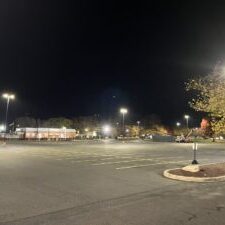
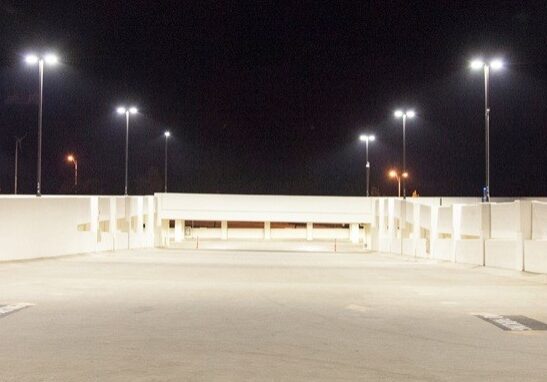
When a site needs more than a one-for-one fixture swap, the design process starts at the site plan rather than a vendor's catalog. We model each zone independently, parking fields, drive aisles, pedestrian crossings, building entries, and perimeter areas, and calculate footcandle levels and uniformity ratios before a single fixture is selected. That sequence eliminates unnecessary fixtures, right-sizes the energy load, and produces documentation that holds up to scrutiny, whether that scrutiny comes from a rebate reviewer, an insurer, or opposing counsel after an incident.
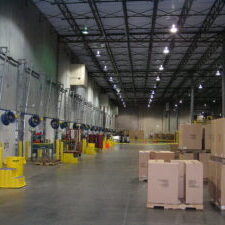
The same standard applies whether the project is a parking field, a retail interior, an office, or a warehouse. OSL works as a single source across interior and exterior lighting, so a property manager coordinating a multi-building site is not managing one specification for the parking lot and a separate, uncoordinated one for the lobby. Color temperature, controls strategy, and fixture quality follow the same standard throughout, because a property that reads as inconsistent from the parking lot to the back office reads as poorly managed, even when every individual fixture is technically working.
Our specifications are written to performance parameters, not product lines. We source the fixture that fits the site from 25 years of manufacturer relationships, which keeps a property manager from being tied to a single vendor's catalog for the life of the asset.
Documentation That Travels With the Property
Property management turnover is routine. A regional manager changes roles, a portfolio is sold, a maintenance contract moves to a new vendor. What should not change is the record of what is on the property and why. OSL holds the specification, fixture records, manufacturer relationships, and order history for every site we touch, independent of who happens to be managing the property at any given moment.
That continuity shows up in practical ways. A rebate application needs a measured baseline, which the survey already produced. An insurer or an auditor asking for proof of a documented lighting standard gets a record that already exists rather than one assembled against a deadline. A new property manager inheriting a site OSL has worked on inherits the specification history along with it, instead of starting over with a vendor who has never seen the asset.
Warranty and Repair: What Happens When a Fixture Fails
When a fixture fails on a property under your management, the warranty process typically lands on your desk: identifying the product, locating the original specification, and figuring out what the manufacturer requires before they will honor the claim. On a site OSL specified and installed, that process looks different, and it runs in three steps.
Report. Your maintenance vendor or on-site electrician submits the issue through OSL's online warranty form. You do not need to identify the product or locate any paperwork, because we already hold the fixture records, order history, and manufacturer relationship for that site.
Build the package. Our warranty team reviews the submission, identifies anything missing, such as photos, a fault description, or a voltage confirmation, and follows up with your vendor directly to collect it.
Track to resolution. We submit the completed package to the manufacturer and track the claim through to resolution, keeping you informed along the way. You stay updated. The paperwork stays with us.
That process changes when a property changes hands. Manufacturer warranties are technically non-transferable at sale, but because OSL holds the original order numbers and specifications, we can often facilitate a claim for a new owner who reaches out through our existing project records. It also has a clear boundary: warranty management covers products OSL specified and installed. We do not manage claims on fixtures sourced or installed by another vendor, because we cannot stand behind documentation we never created. For a property with an unknown lighting history, a survey is the step that establishes a documented baseline going forward.
Why the Response Holds Up Across Every Market
None of this depends on one office being close to the property. Our in-house electrical engineers are licensed across the lower 48 states, with Alaska and Hawaii available by request, and a network of more than 400 contractors gives us working relationships in the markets where our clients actually operate. For a property manager with sites in several states, that means the same process, the same documentation standard, and the same point of contact, regardless of which property is calling.
It is also why OSL structures the relationship as a lifecycle rather than a series of separate transactions. Survey, design, installation, and optimization build on one another, so a warranty claim filed five years after installation draws on the same record created at the survey stage. Across more than 7,200 projects, that continuity is what makes a fast response a reliable one, not just a lucky one.
Who This Is Built For
This is built for property managers and owners responsible for keeping a property, or a portfolio of them, running without carrying every lighting decision personally. It serves regional and national operators who need one process and one point of contact across multiple markets, and it serves a property manager handling a single site who would rather hand a lighting issue to a partner who already has the records than reconstruct them under deadline. It is not built for a one-time fixture purchase with no interest in what happens after installation. For everyone else, this is the infrastructure that makes the next urgent call easier than the last one.
A Practical Next Step
If your properties already carry OSL-installed lighting, the direct path for a current issue is the warranty form itself. If you are evaluating a partner for survey, design, documentation, or ongoing warranty support across a property or a portfolio, the conversation starts with an honest look at what is already on the ground.
On-Site Lighting & Survey offers a free project review for property managers and owners who want a clear picture of their lighting infrastructure before the next urgent call comes in, covering survey, design, documentation, and warranty support under one process and one point of contact. Start at our Get Started page or reach Marshall directly at 763-682-7114.
Marshall Tromborg | CEO and President, On-Site Lighting & Survey
Direct: 763-682-7114 | [email protected] | onsitelighting.com
7,200+ projects since 2001. Electrical engineers licensed in all lower 48 states. Alaska and Hawaii are available by request.